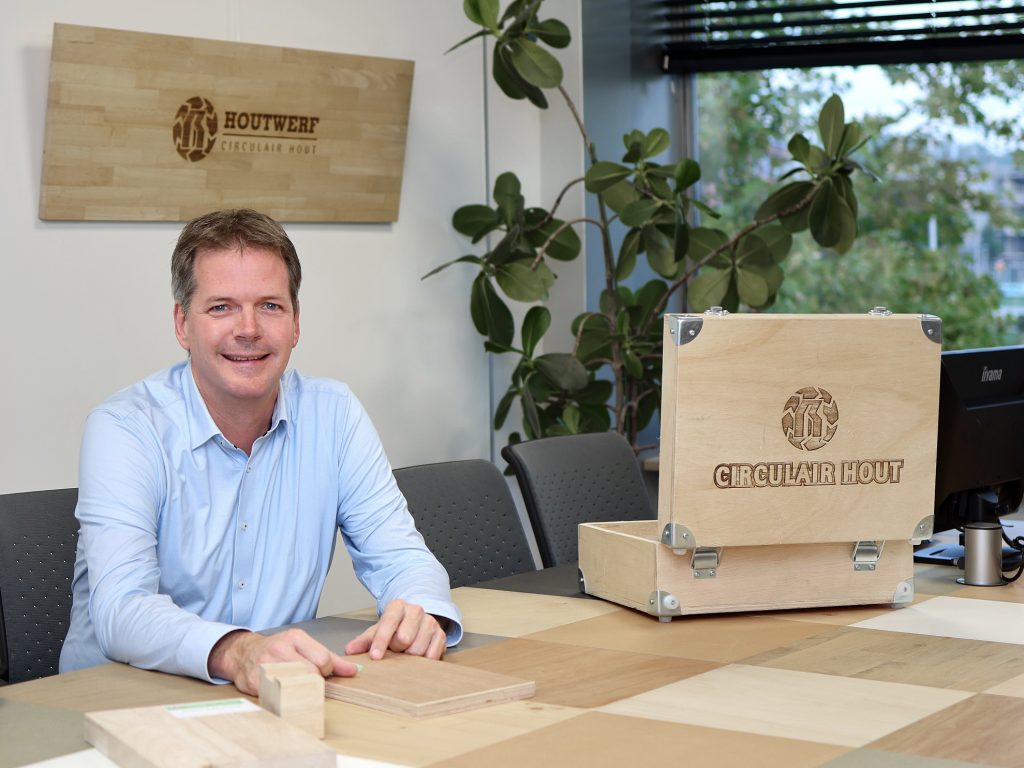
Houtwerf in Houtwereld on formaldehyde-free
We can’t say it often enough: formaldehyde-free plywood is readily and affordably available. And more and more users are discovering this for themselves. In the November 2023 edition of Houtwereld, our director Pieter Verbeek explained how Houtwerf is raising the bar with sustainable and circular sheet materials, such as Powerplex Bio and Stabiofloor—panels that are now widely embraced by resellers, contractors and interior builders.
Breaking with the standard
Traditionally, plywood is bonded with adhesives that contain formaldehyde—a substance that contributes to indoor emissions and has an impact on people and the environment. Alternatives are often difficult to obtain or significantly more expensive.
Houtwerf demonstrates that there is another way. With a plywood and an underlayment bonded with a biobased, formaldehyde-free adhesive, we prove that sustainability and quality go hand in hand.
A family business with vision
“Our timber trade has existed since 1932,” says Pieter Verbeek. “We are a family-owned company with locations in the Netherlands, Belgium and France, supplying DIY chains, trade, contractors, industry and interior builders.”
For Houtwerf, sustainability is not a trend but a conviction. “We have been FSC- and PEFC-certified since 2004, but we now regard that as the baseline. As early as 2007, we started working on circularity—at that time mainly for government projects. Wood is naturally ecological and renewable, but we always want to see whether we can take it one step further.”
A good example is Rubberwood, developed from agricultural waste from rubber tree plantations. “After 25 years, rubber trees are felled and replanted. By processing the wood from these trees into sheet material and timber panels, we give it a second life cycle. No additional forest is cut for it. Moreover, Rubberwood is formaldehyde-free and suitable for a wide range of structural and decorative applications.”
The discovery of biobased adhesive
In 2019, Houtwerf found a revolutionary bean-based adhesive in China: fully biobased and non-toxic. This enabled us to introduce Powerplex Bio—a plywood whose price is barely higher than conventional panels, yet that performs even better in terms of quality.
“In our tests, we almost reach the WBP standard for water resistance,” Verbeek explains. “This means that Powerplex Bio is more durable and more moisture-resistant than standard plywood. In addition, the product is officially classified as ‘formaldehyde non detected’, in other words: it contains no measurable amount of formaldehyde.”
Growing demand for healthy materials
Interest in formaldehyde-free panels is growing rapidly, particularly from ecological construction projects. Demand in the DIY market is also increasing. Hornbach, for example, has now fully switched to Powerplex Bio.
“We notice that the trade still needs some explanation,” Pieter says. “That is why we plan to add QR codes to our panels, so that users can directly view information about origin, composition and environmental performance. This way, we make the story behind our products transparent and accessible.”
On the way to the future
With products such as Powerplex Bio, Stabiofloor and Rubberwood, Houtwerf shows that the future of wood and sheet materials is biobased, circular and formaldehyde-free.
What once started as a family business with a passion for wood has grown into a pioneer in sustainable sheet materials. And we are doing this not only for today, but for the generations to come.